
Is Moraine Lake open in October? Yes, but only for part of the month. In 2026 the shuttle season ended on October 12, and the road is now closed for the winter. Until it reopens next season, you can’t drive or take a shuttle in. Early October and late October can feel like two completely different trips — one still has a real shot at the golden larches in Larch Valley, the other is a Lake Louise day with a warm drink at the end of it.
Quick facts
- Shuttle season: ended October 12, 2026; next year’s dates aren’t announced yet
- Larch colour window: late September through early-to-mid October
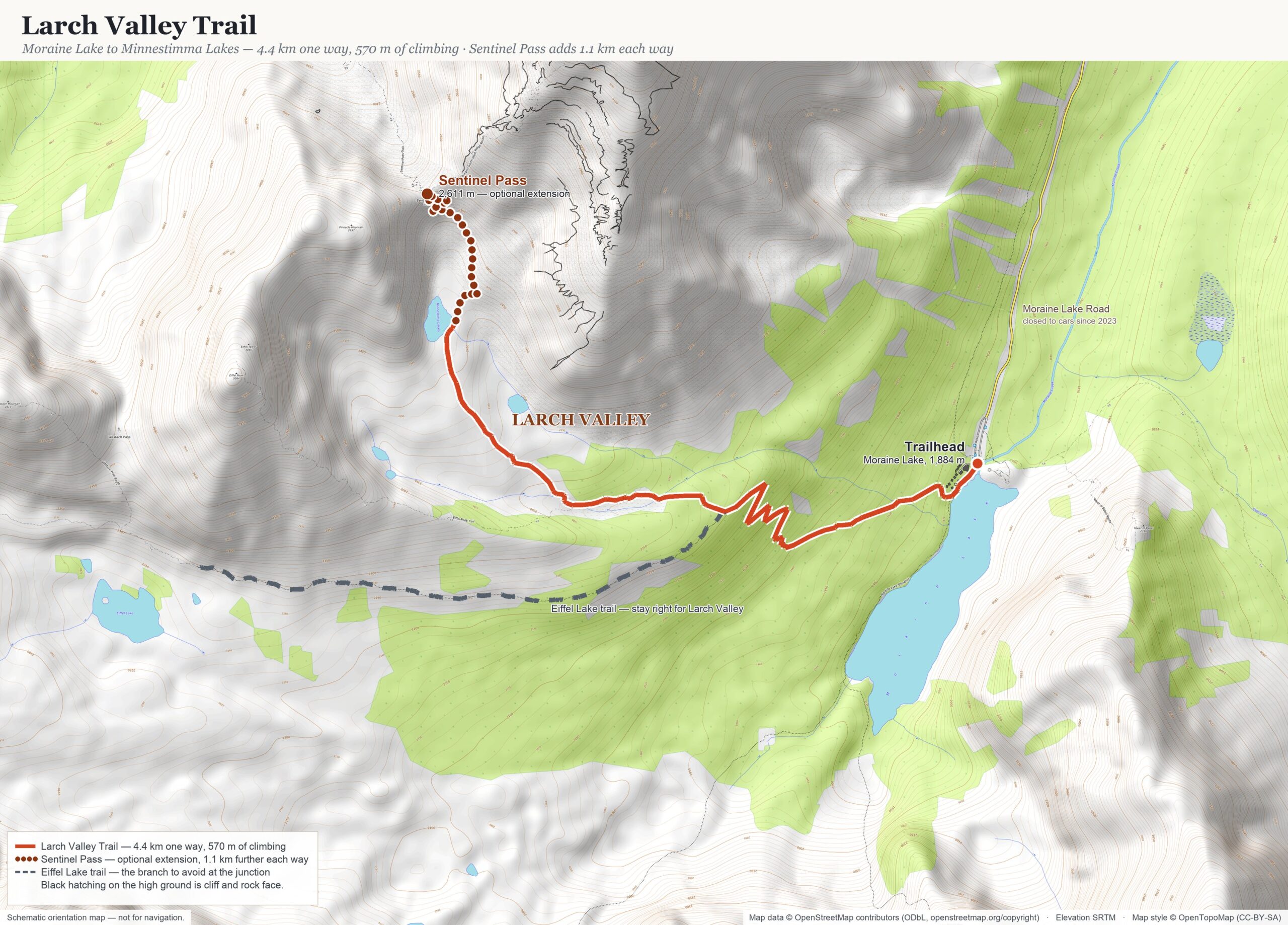
- Larch Valley round trip: about 9 km and 570 m of climbing to Minnestimma Lakes, 3.5–4 hours of walking (roughly 7 km if you turn around at the larch forest itself)
- Sentinel Pass extension: 11.2 km round trip, 750 m of climbing, 4.5–5.5 hours — a whole-day total, not extra on top
- Moraine Lake Road: closed to personal vehicles year-round since 2023; shuttle or nothing
As of September 2026
⚠️ This isn’t a casual walk. Larch Valley is a proper hike — several hours of steady climbing before you reach the larches. Mountain weather can change fast, too: a clear morning can turn into fog, strong wind or freezing rain once you’re higher up. There’s no cell service at Moraine Lake and not much shelter at the shuttle stop, so after a long hike you could be standing outside waiting for the bus in the cold. Pack for the hike you might get, not the morning you started with.
Our Lake Louise and Moraine Lake day plan covers the classic visit to both lakes. This one is more focused on October — whether Larch Valley is worth the climb, how much time you really need for the hike and the shuttle, and what the day looks like once Moraine Lake is no longer part of the plan.
When should you go for the golden larches?
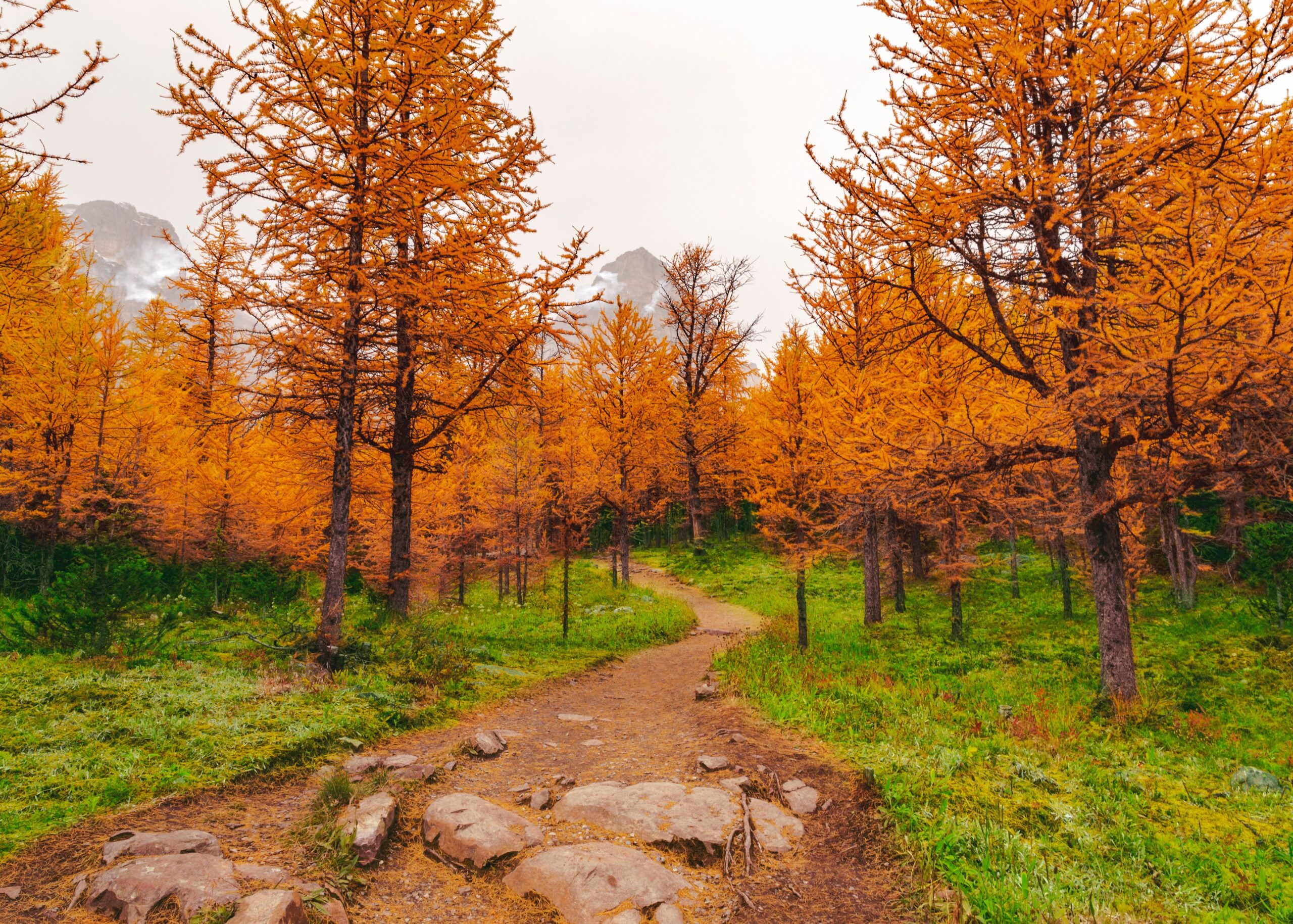
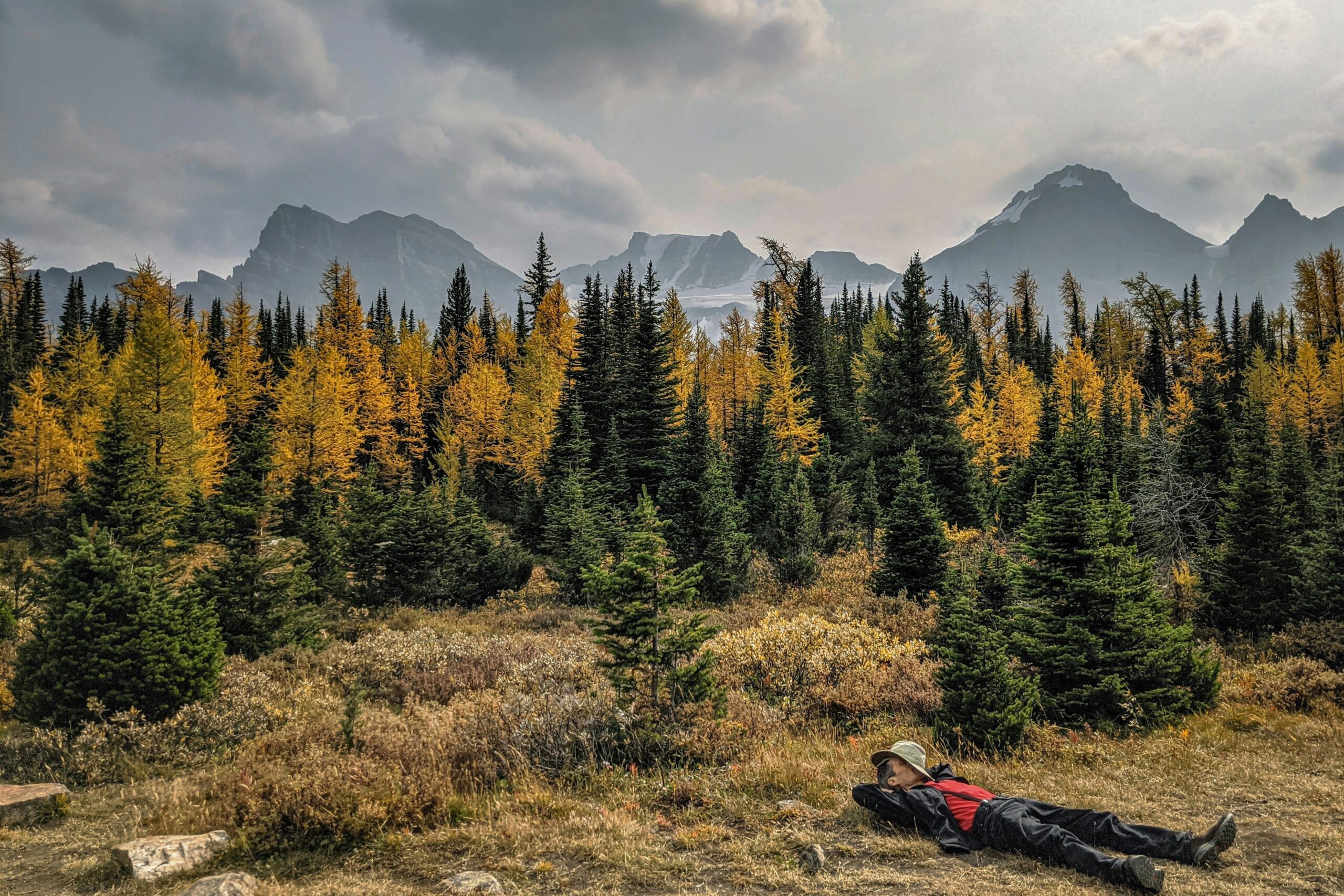
The first week of October is your best remaining chance to see Larch Valley at its golden best.
Larches are unusual conifers. Every fall their needles turn bright golden yellow before dropping for the winter. The colour doesn’t last long, which is why timing matters so much. The best colour usually lands somewhere between the last two weeks of September and early October.
By the second week of October, you’re taking your chances. And there’s another date to keep in mind: the last day of the Moraine Lake shuttle season, which was October 12 in 2026. Miss the colour entirely and the autumn drive along the Icefields Parkway is still there, with no reservation window to beat.
These two dates are easy to mix up, but they mean completely different things. October 12 is a transport date. The shuttles stop running, so you can plan around it fairly confidently. Peak larch colour is a weather date. There’s no fixed day when the trees turn gold. A cold snap can bring the colour early; warmer weather can push it later. You could ride the shuttle on October 11 and find most of the needles already down, or arrive on October 3 to a spectacular display.
So book the trip around the shuttle dates, and keep your expectations about the trees a little flexible.
Want the best possible chance of golden larches? Move the trip into late September. That’s when the odds are genuinely good. By October, Larch Valley is already heading toward the end of its season, and by the second week it’s worth planning the day around Lake Louise first and treating the larch hike as a bonus rather than the reason you booked. When the larches are one part of a longer trip rather than the whole point of it, three days in Banff gives the weather somewhere to go wrong without wrecking the week.
If you have two days in the area, there’s a simple way to play it. Save the better forecast for Larch Valley and keep the less certain day for Lake Louise, which still works when the weather doesn’t. One more tip: sort out transport before committing to the rest of the day. Some flexibility in your shuttle booking makes it much easier to swap your hiking day when the forecast changes, and that’s far harder once you’ve paid for a fixed-time tour. How early you have to be up for all this depends a lot on which town you sleep in.
Getting to Moraine Lake
Start at the Lake Louise Park & Ride at the ski resort, 1 Whitehorn Road. This is not the same place as the Lake Louise lakeshore, and that distinction matters — showing up at the wrong lot with a Moraine reservation is a surprisingly easy way to lose your check-in window.
For a hiking day, book a morning shuttle and make Moraine your first stop. Larch Valley can take most of the day, and you want your best daylight on the trail, not saved for when you’re already tired.
Reserve through the Parks Canada booking system. Don’t panic if the first batch of seats is gone — another 60% is released at 8 a.m. Mountain Time, two days before travel, so it’s worth setting an alarm and trying again. Until you actually have a confirmed seat, keep a backup plan. A later shuttle still works for visiting the lakeshore, but it’s a much bigger compromise when you’re planning a hike that takes several hours.
In 2026, Parks Canada’s Moraine Lake shuttles ran every 30 minutes from 6:30 a.m. to 5 p.m., with the last direct return at 7:30 p.m. The Lake Connector between the two lakes ran 7 a.m. to 6 p.m. That last Connector time matters: the final Connector leaves Moraine at 6 p.m., well before the last direct shuttle back to the Park & Ride. If you’re still at Moraine after 6, don’t count on hopping over to Lake Louise — catch the direct Moraine shuttle instead. Our shuttle and parking guide goes deeper into bookings, fares and change policies; this is the part that matters for an October trip.
Give yourself a turnaround time
Before you start hiking, decide when you need to turn around. Don’t wait until you reach the top and then start doing the math. Work backwards from the shuttle you want to catch, and allow for the descent, a quick stop at the lake, peeling off or adding a layer, and the walk to the bus.
It’s much better to aim for an earlier shuttle and finish with time to spare than to make the last bus your target. And if the climb is taking longer than expected, turn around early. Don’t try to make up time by racing downhill — October trails can be wet, icy or slippery, and a twisted ankle is a pretty miserable way to end a mountain day.
Remember there’s no real shelter at the Moraine shuttle stop. When you finish, you may still be standing outside in cold, wind or rain waiting for the bus. Keep a dry warm layer for the ride home, not just for the hike.
How early do you really need to go?
Alpine Start runs 4 a.m. and 5 a.m. departures, which makes sense if you’re going specifically for first light over the Ten Peaks. For everyone else, earlier doesn’t automatically mean better. A regular morning departure usually gives you a full day without turning the trip into a middle-of-the-night mission.
Coming from Banff without a car? Compare Roam’s Reservable Super Pass against commercial tours that give you enough time at Moraine to actually hike. A standard Lake Louise sightseeing ticket doesn’t necessarily include Moraine access, so check exactly what’s included before booking. If nothing’s booked yet, basing the trip nearer Lake Louise takes an hour of dark driving out of the morning.
The hike to Larch Valley
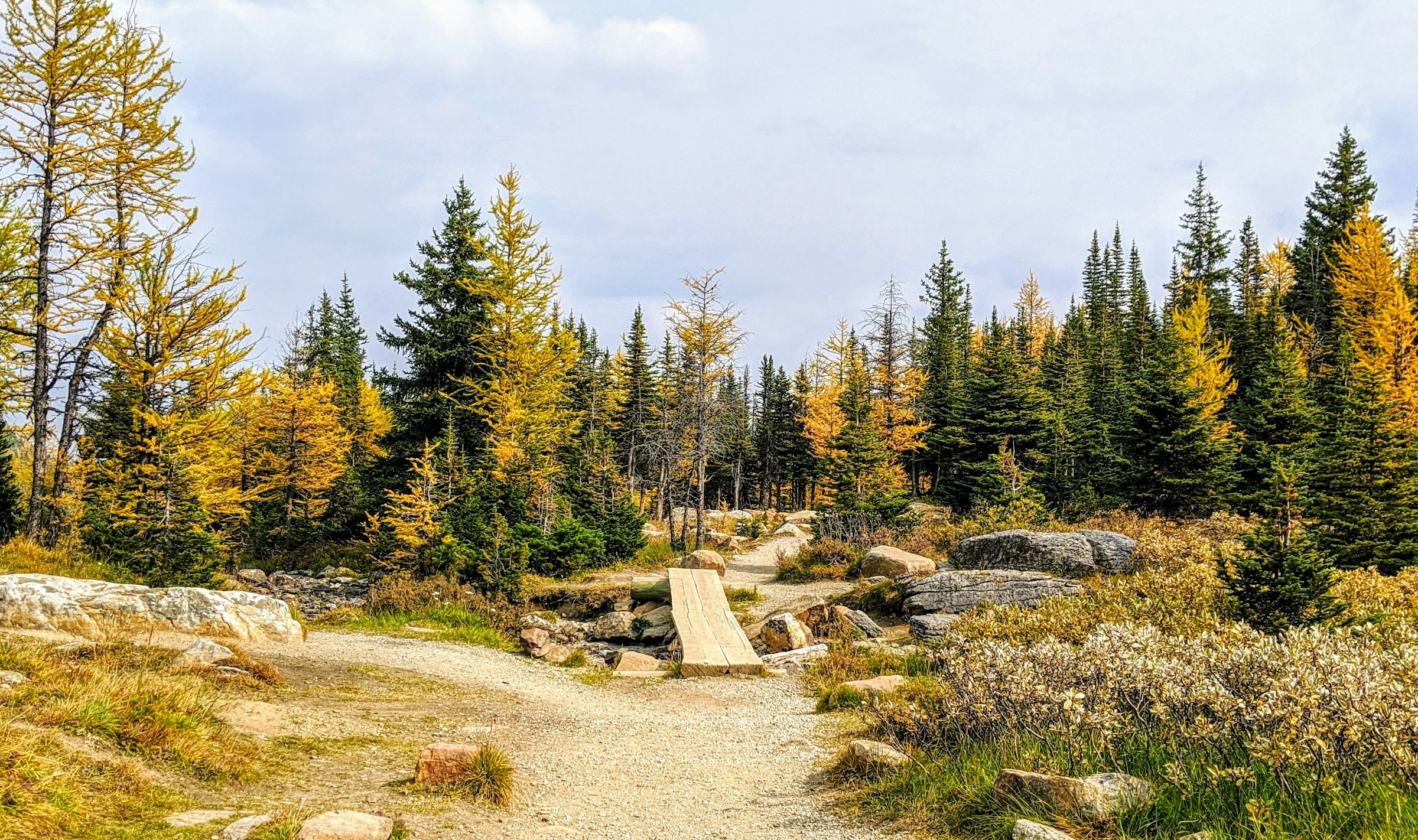
You’ll spend the first part of the hike earning the view.
The trail climbs steadily away from Moraine Lake through ten switchbacks — five shorter, five longer. At a steady pace that first section takes roughly 50 minutes. It feels like work at the start, but once the trees open and the larches appear, you’ll understand why people make the climb.
One thing that may surprise you: Larch Valley is steep, but it isn’t a technical hike.
There’s no scrambling, and no sections where you need to use your hands. The trail is generally straightforward underfoot, with relatively few rocks or roots to negotiate. The challenge is simply the long, steady climb.
That’s an important distinction. You don’t need technical hiking skills here. You need enough fitness — and patience — to keep climbing for several hours.
Some visitors are perfectly happy staying by the lake with the blue water and the mountain views, and that’s completely fine too. Larch Valley is a real hike, so there’s no reason to talk someone into it if hiking isn’t what they came for.
The trailhead is just past Moraine Lake Lodge, and the lakeshore trail starts nearby as well. Check the signs before setting off — you don’t want to follow the first group out of the parking area onto the wrong trail. Download your map before you start, because you’ll lose cell service along the way.
Take it at the pace of the slowest person in your group, and take a short break before anyone feels they need one. A comfortable 9 km walk around town doesn’t really prepare your legs for the same distance with 570 metres of climbing in it.
About halfway up you’ll reach a signed junction for Eiffel Lake. Stay right for Larch Valley. You’re also hiking through bear country, so make noise as you go and keep the group together, especially through the quieter stretches.
When the larches finally appear
Once you reach the larch forest, slow down. This is the part you climbed for.
The trail keeps gaining elevation toward Minnestimma Lakes, so reaching the larches doesn’t mean you’ve reached the end of the hike. How far you go should depend on the weather, the time you have, and how everyone is feeling. One visitor in our collected trip reports described a five-hour day here — we don’t know their exact pace or year, but it’s a useful reminder that the 3.5–4 hour walking estimate can run long. Don’t build an afternoon that leaves no room for delays.
Minnestimma Lakes, at about 2,400 metres, make a natural turnaround when conditions and energy are good. There’s nothing wrong with stopping earlier, either — once you’re past the forest and the valley has opened up, you’ve had the day. The goal isn’t to reach every labelled point on the map.
Here’s something first-timers often get wrong. Once you reach the larches, it’s tempting to think you’ve seen the main attraction, take a few photos and turn around. But the really big view comes a little farther on — above the tree line, where the valley opens up and the surrounding peaks come into view.
So if your legs are still feeling good and you have enough time before the shuttle, keep going beyond the forest before turning around. That extra stretch can make a big difference to the experience.
Keep a snack and a spare layer somewhere easy to reach; you’ll want both higher up, especially when you stop for photos. And don’t switch off on the way down. Descending on tired legs can be as demanding as the climb, particularly if the trail is wet or icy. Take your time, watch your footing, and save the serious photo scrolling for the shuttle ride back.
Should you push on to Sentinel Pass?
Only if the group still feels good, the trail conditions look reasonable, and you have plenty of daylight left to get back down.
Sentinel takes you beyond Larch Valley, climbing steep switchbacks toward the high point between Larch and Paradise valleys. The full round trip from Moraine comes to 11.2 km and 750 m of climbing, 4.5–5.5 hours of walking — whole-day totals that already include the valley hike, not extra distance stacked on top.
Think of it as an optional extra rather than the main goal of the day. If the golden larches were the reason you came, another 45 minutes of climbing may be worth less than more time among the trees. And if you’re watching the clock for a return shuttle, or your knees have already had enough, make that call before you start climbing again.
⚠️ Snow changes this fast. Parks Canada advises against travel on Banff’s moderate and difficult high-elevation trails from mid-October through mid-June because of avalanche exposure, and winter conditions can arrive outside that window too. Check the current trail report and park bulletins before you set out. Ice cleats help with grip on slippery sections, but they don’t make avalanche terrain safe — and other hikers heading up doesn’t mean conditions are safe for you.
For most October visitors the sensible plan is to enjoy Larch Valley and head back toward Moraine. Continuing over the pass into Paradise Valley turns this into a much bigger outing with different route-finding and transport to arrange — a trip of its own, not something to squeeze in because you have a little time left.
What to wear, what to pack, and what October actually feels like
October in the mountains can be beautiful, and it can change its mind quickly.
Check the trail report and forecast the evening before, then check again in the morning. Pay attention to the date on the trail report, too — a photo from three weeks ago, or dry pavement down at Moraine, doesn’t tell you much about what the trail looks like higher up today.
Mornings can be cold. Parks Canada’s climate data for Lake Louise shows October averages around 8°C during the day and −5°C overnight. Those are long-term averages rather than a forecast, and the trail climbs well above the village, so it can be noticeably colder up there.
Layers are the easiest way to dress: a warm mid-layer, a windproof or waterproof shell, hat and gloves. You’ll warm up climbing and want layers off, then need them again the moment you stop. Bring real warmth even when the morning feels mild — there’s nowhere halfway up the trail to escape the cold.
You’ll feel the mountain changing as you climb.
The shuttle ride may be warm and comfortable. A little later, the switchbacks might have you sweating. Then you reach the valley and suddenly the wind picks up, the sun disappears behind the peaks, and you’re reaching for another layer.
That’s why layers matter so much here. You’re not preparing for one October temperature. You can experience several completely different conditions between the parking lot, the climb and your lunch stop.
Watch the weather change
Fog is the biggest surprise for first-time visitors. You can leave Moraine under clear skies and reach the valley with the peaks completely hidden. Wind and cold rain arrive just as quickly.
That doesn’t automatically mean cancel. It means being ready for conditions very different from what you saw at the parking lot. And when visibility drops, especially higher up toward Sentinel Pass, turning around is often the smart call. There’s no prize for pushing on when you can’t see the terrain around you.
What to pack
- Food and water for the whole outing, with extra in case it runs long — pack lunch before you leave, since seasonal services at Moraine are already winding down by October.
- A downloaded map and your saved shuttle confirmation, on a fully charged phone. There’s no cell service at the lake once you need it.
- A small first-aid kit, an emergency warm layer, and whatever emergency communication you actually know how to use. Tell someone your route and when you expect to be back.
- Bear spray somewhere you can reach quickly, not buried at the bottom of your pack. Everyone in the group should know where it is and how it works.
October is still bear country. Follow the group-size requirements or closures posted for the day you visit rather than an older rule you found online. Keep food secure, pack out everything, and give wildlife plenty of space. Before you start climbing, use the pit toilets at Moraine — there’s no running water at the lake, so fill your bottles before you head onto the trail.
Does Larch Valley work for kids, new hikers, or a wheelchair or stroller?
Age isn’t really the deciding factor. Recent hiking experience matters much more.
A kid who enjoys several hours walking uphill may handle Larch Valley better than an adult who hates long hikes. Add cold October weather, a long climb and a fixed shuttle time at the end, and it becomes a lot for someone who wasn’t excited about the hike in the first place. When you’re unsure, start with the Moraine lakeshore and the Rockpile instead — you still get the scenery without committing everyone to hours on the trail.
Hiking with kids
Agree before you set off that turning around early is completely fine. You don’t have to reach Minnestimma, or even get through the whole larch section, for the day to be worth it.
Pack snacks that are easy to grab during short breaks, and bring extra warm clothing — kids cool down fast when the group stops, even if everyone was comfortable walking. If someone’s carrying a child, that extra weight makes a long uphill considerably harder, so let it shape your turnaround point rather than deciding the distance before you start. It’s also worth keeping the rest of the day easy; after several hours on the trail, another major hike usually isn’t necessary. Families often find a day like this sits better inside a three-day plan for first-timers, with something gentle booked for the morning after.
What about a stroller or wheelchair?
Make this a lakeshore visit rather than a Larch Valley hike — the trail climbs steeply and isn’t built for either. Parks Canada does offer an accessible shuttle on request with a regular ticket, though it isn’t available on Alpine Start; mention your needs at Park & Ride check-in so they can confirm the vehicle arrangements. Check which sections of the lakeshore path suit you before setting out, too. In October, frost and changing conditions can make surfaces less predictable than they look in summer.
Three ways to actually spend the day
There isn’t one right way to do Moraine Lake in October. Your timing, the weather and how much hiking your group wants all change the shape of it.
Early October: make Larch Valley the main event
Have breakfast and pack lunch before heading to the Park & Ride. At Moraine, use the toilets, check your return time against the posted shuttle schedule, and start hiking while you still have most of the day ahead of you.
Spend the middle of the day in Larch Valley. Continue toward Minnestimma if the group is moving well and conditions are good, or turn around earlier and enjoy the larches without squeezing every kilometre out of the trail. Leave Sentinel Pass as a decision you make on the day.
As a rough guide, starting around 9 a.m. could put you back at the lake somewhere between 1 and 3 p.m. — timing varies with pace, photo stops and conditions, so don’t treat that as a schedule. Once you’re back, see how much energy the group has left. Lake Louise is there if everyone wants more; otherwise call it a day. The second lake should be a bonus, not pressure on finishing the hike.
Early October: see both lakes without the big hike
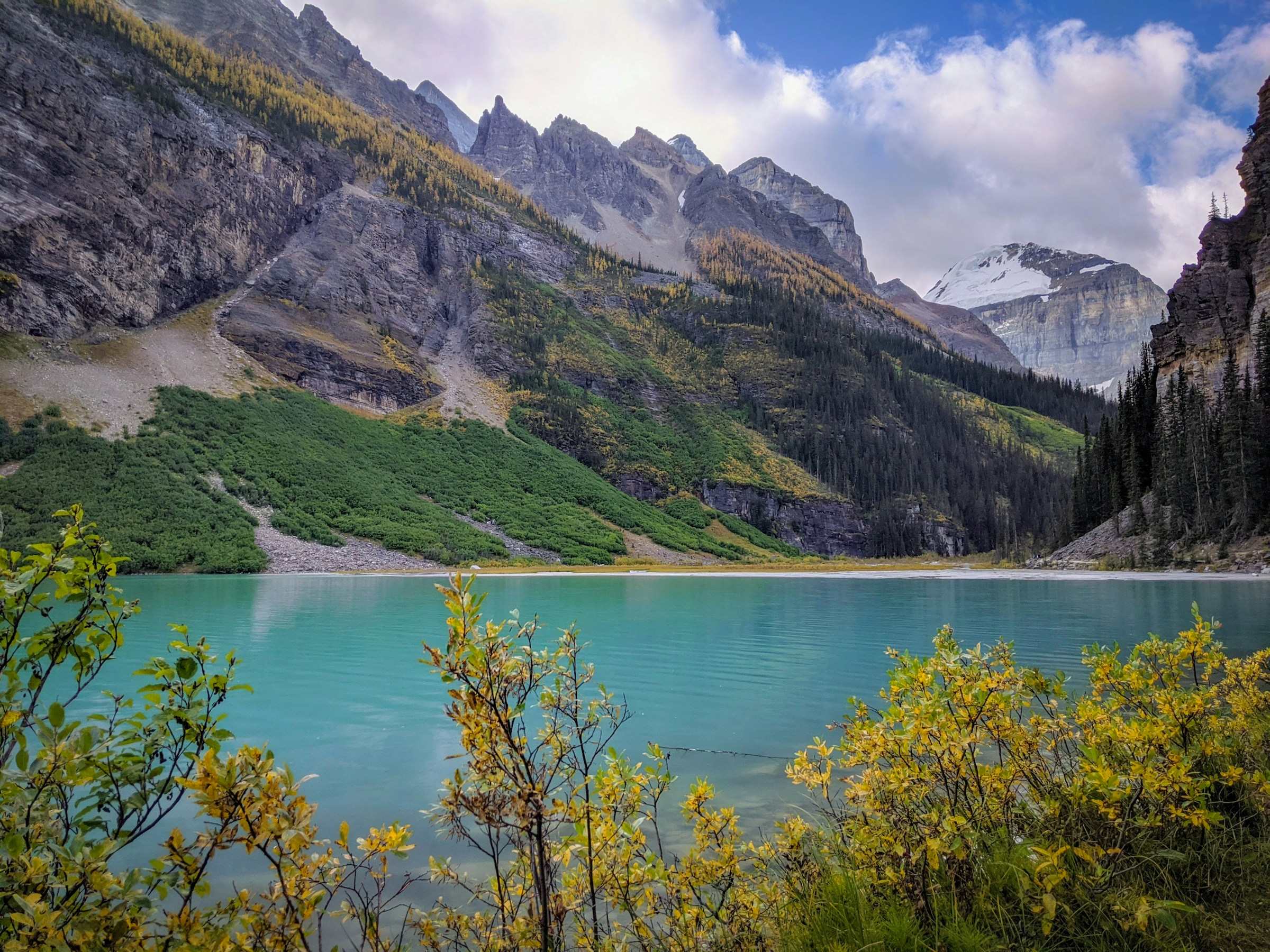
Not everyone wants to spend half the day climbing, and that’s completely fine.
Take a morning reservation to Moraine and spend time around the water first. The Rockpile loop and the lakeshore trail are both short and easy, and they give you the classic views without committing to Larch Valley. Go up the Rockpile early if you can — it’s the same viewpoint the sunrise crowd comes for, and by mid-morning the light has gone flat. When you’re ready, take the Lake Connector to Lake Louise, leaving time for the transfer, a possible queue and lunch rather than running the day to the minute.
At Lake Louise, start by the lake itself. From there, decide whether everyone wants more shoreline or somewhere warm for a drink — the full two-lake walkthrough has the order and timings worked out if you’d rather not improvise. For families, mixed-ability groups, or anyone who just doesn’t want a long mountain hike, this is the most relaxed way to see both lakes in a day.
After October 12: make Lake Louise the whole day
Once the shuttle season ends, the plan changes. Lake Louise village and lakeshore stay open year-round; it’s Moraine and the road in that close for the winter. Roam’s 8X between Banff and Lake Louise keeps running year-round, on a new fall and winter schedule from October 13, but Moraine Lake itself stays closed until next season. With Moraine off the table, the drive north toward the Columbia Icefield becomes the obvious big day out instead.
Make Lake Louise the centre of the day: time around the lake, as much of the shoreline as conditions allow, then into the village for something warm. Book your return transport before leaving Banff — the village and the lakeshore aren’t right beside each other, so don’t assume you can sort the bus out later. Late in the season there’s a decent argument for staying up at Lake Louise for a night instead of commuting twice.
And don’t improvise at Moraine once the shuttles stop. Don’t walk or drive Moraine Lake Road because the gate looks open or the road looks empty — in winter it passes through avalanche terrain, and an empty road isn’t an invitation. Same goes for ice forming on the lake: it might look solid, but that tells you nothing about whether it will hold a person, and Parks Canada doesn’t monitor it for skating.
Canoes and tea houses run on their own calendar
Not everything follows the shuttle season.
Leave canoeing at Moraine out of your October plans — Moraine Lake Lodge’s rental dock typically runs mid-June to mid-September, so shuttles continuing into October doesn’t mean you can still rent a canoe. Lake Louise is different: canoe rentals there are run separately on their own schedule, so check directly with the boathouse rather than assuming it matches Moraine.
Lake Agnes Tea House closes in the first week of October, so for most October trips plan on it being shut and bring your own lunch. The Plain of Six Glaciers tea house can also have a shorter season, so check its current dates before building a day around it. That bit of planning saves a long hike ending in a very hungry surprise.
Neither hike is a simple late-season backup for Larch Valley, either. Both head into high mountain terrain where conditions change quickly, so treat the season and the trail conditions as two separate checks — an attraction being open doesn’t mean the hike suits that day.
Planning a few days in the area? Give yourself some flexibility: save the clearest day for your biggest hike and keep the others easy to move. Our three-day Banff itinerary helps with the bigger picture. You don’t need Larch Valley, Sentinel Pass, both lakes and a tea house in one heroic day.
Frequently Asked Questions
Is Moraine Lake open in October?
Yes, but only while the seasonal shuttle is running. In 2026 the last day was October 12, and the road is now closed for the winter. Once it closes, no vehicles, including shuttles, can use Moraine Lake Road until the next season.
When do the larches turn gold at Larch Valley?
Usually from late September into early October. There’s no exact date — weather can push the colour earlier or later, so treat any window as a general guide rather than a guarantee.
Can you visit Moraine Lake without hiking Larch Valley?
Absolutely. The Rockpile viewpoint and the lakeshore trail are both short, straightforward walks, and they’re a good fit when you mainly want the lake and mountain views. Plenty of people come purely for the early light on the water and never set foot on a trail.
Is there cell service at Moraine Lake or on the Larch Valley trail?
No. There’s no cell coverage at Moraine Lake or along the Larch Valley trail. Download your map and save your shuttle confirmation before you leave, and tell someone where you’re going and when you expect to be back.
Do you need bear spray for Larch Valley in October?
Yes — it’s still bear country in October. Carry it somewhere you can reach quickly, keep the group together, and follow whatever group-size guidance or closures Parks Canada has posted for that day.
Is Sentinel Pass safe to add onto the Larch Valley hike in October?
That depends entirely on conditions that day. Sentinel is a much more demanding extension, and things change quickly higher up. Parks Canada advises against travel on moderate and difficult high-elevation trails from mid-October through mid-June because of avalanche exposure, and winter conditions can arrive earlier. Check the current trail report and park bulletins before you start, not once you’re already climbing.


Leave a Reply